
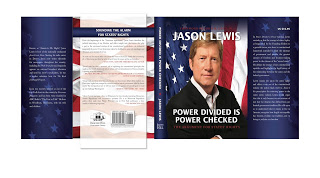
If there's a better lesson in devolving power from Washington than federalism and states' rights, I don't know what it is. That's why I wrote a book about it. And after hearing from so many of you who wanted an audio version of Power Divided is Power Checked: The Argument for States' Rights, I'm happy to announce that it's now available at Audible (just CLICK IMAGE above), Amazon or iTunes.
Here it is, nearly four hours narrated by yours truly and devoted to what the framers called 'dual soverneignty' or the division of power. You'll hear me explain the constitutional framework intended to limit the missteps of government and provide the greatest amount of freedom by not allowing the consolidation of power in the nation's capitol--and in the process, what the much derided concept of 'states' rights' really means. It's an in-depth look at our republican architecture that highlights the legal history of the relationship between the states and the federal government.
Moreover, in the new BONUS COMMENTARY (only available in the audiobook), I update the text to include how this summer's Supreme Court rulings related to health care, same-sex marriage, immigration, religious liberty and property rights continue the erosion of constitutional protections and what we can do about it. It's all right there so downlodad it on your device now with the free Audible app on Apple, Android, and Windows devices. Great for commutes, long drives, or just to catch up on a little constitutional history at home.
“A must read for anyone who cares about the future of America. Lewis does an amazing job of illustrating just how far we’ve strayed from the course set by our founders.” ~ VINCE FLYNN (1966-2013), NEW YORK TIMES BEST-SELLING AUTHOR
“Jason Lewis has done a yeoman’s job in explaining the constitutional principles that made us the world’s freest and richest nation and how abandonment of those principles is proving to be our undoing.” ~ WALTER E. WILLIAMS, JOHN M. OLIN DISTINGUISHED PROFESSOR OF ECONOMICS GEORGE MASON UNIVERSITY
“Great book, and about time! Jason Lewis lays out the primary debate of the modern era. Have states’ rights been usurped by a massive, activist federal government, aided by liberal courts? The real question now is: will one state (or one governor) have the guts to stand up and challenge Washington?"~THE HONORABLE ROD GRAMS (1948-2013), FORMER US SENATOR (R-MN)
The audio version Power Divided is Power Checked: The Argument for States' Rights, available now at Audible (just CLICK IMAGE above), Amazon or iTunes.
HUMAN EVENTS Review by Christian Toto
24 February 2011
"Radio talker Jason Lewis isn’t content just spreading his brand of conservatism over the nation’s airwaves. His new book, Power Divided Is Power Checked, makes the case in a different medium, one which lets him expand on views that don’t fit into a tidy radio show segment. One only has to look at the current state of the nation—and an administration eager to expand the government at every corner—to understand why he’d embrace the written word to double down on his theme.
Lewis’ book, subtitled The Argument for States’ Rights, leans on his rich knowledge of judicial history to not only break down where many modern problems started but explore ways to return the country to its origins. “What the founders envisioned was a collection of states able to unite on a few national goals, but only when there was broad consensus,” Lewis writes. State officials can be just as ignorant of the Constitution as their federal peers, but smaller geographic boundaries give local citizens more power to vote out misguided politicians. And the consequences of a state politicians’ behavior don’t affect every single citizen. America is a divided nation, in part because it has drifted from its constitutional moorings. It’s no accident that three of the most heated issues of our age—health care, border control, and gay marriage—will be decided by the courts, not the people, as originally intended.
Power Divided Is Power Checked starts with where the “states’ rights” rhetoric began to splinter—in the wake of the War Between the States. Fallout from the Civil War resulted in a “consolidation of power in Washington that would have been unthinkable at the founding,” Lewis writes. Today’s leaders likely wouldn’t recognize the republic’s original intent. And by overstepping their bounds, these same leaders have helped polarize the nation on issues best left at the state level. The sorry state of the Environmental Protection Agency stands as a prime example of Lewis’ fears come to life. States such as Texas are gearing up to fight pending new rules by the EPA that would enforce draconian cuts on energy use that will help cripple the economy. Giving federal agencies such unfettered power is precisely what the country’s founders railed against.
In Chapter 3, Lewis breaks down the history behind “due process,” detailing how its definition has changed drastically over time. The slow drift has left us with “federal judges to endlessly rule over laws whose substance they dislike.” Lewis cites a 1965 court ruling regarding the use of contraceptives, twisting the nebulous Ninth Amendment to the justice’s bidding, as the impetus to a wave of “fictitious rights” rulings—including the right to taxpayer-funded health care coverage. Such legal activism, commonplace today, took root during the turbulent ’60s and shows no sign of abating.
Another entry point for big government remains the “general welfare” clause, something the Obama administration has seized upon with alacrity. Fourteen state attorneys general are gearing up to fight a provision in ObamaCare regarding the law demanding all citizens buy health insurance, cited by its proponents as a natural extension of the general welfare clause. Lewis tracks the debate back to the progressive era and President Theodore Roosevelt, a time when populist views first took serious root in the body politic. Those views can be seen directly manifested in the current federal deficit, perhaps the most dire result of unconstitutional overreach. “The biggest and most intrusive federal government the country has ever seen is now regulating the largest institutions on Wall Street and the smallest on Main Street,” Lewis laments.
But what if citizens decided to stop letting their country chart this calamitous course? Secession is one option, and merely the threat of a state leaving the union could have the desired effect without any real action taking place. Another possible fix involves a new amendment, one that restates the founders’ intentions and reins in the “federal monolith” for good. Such a 28th amendment would state, 'The general welfare clause … shall not be construed to grant the federal branches of government any extended powers not previously or subsequently and specifically enumerated in this Constitution.'
Other, less dramatic, solutions still exist, such as a constitutional epiphany (unlikely), a modern-day Andrew Jackson to stand up against federal overreach, or the installation of judicial elections to keep the wayward in check. Lewis shares some reasons for optimism in an age of an exploding federal government. The wave of new “czars,” combined with ineffective stimulus legislation and forced bankruptcies “reawakened a silent majority,” he writes. The Tea Party movement may be just the grassroots awakening that can steer the country back to its core principles.
And Power Divided Is Power Checked is just the text to guide the Tea Party on the proper path."
To order Jason's book, just click the book cover image to the right.

No comments:
Post a Comment